
Natural Urban Gardens: Keep Chemicals Out of Our Waterways

Many products commonly used in our backyards and gardens, including pesticides, herbicides and fertilisers, contain substances that can affect soil health, wildlife and aquatic ecosystems.
While these products may help control pests, manage weeds or support plant growth, some can have unintended consequences for the wider environment.
What we use in our gardens doesn’t always stay there
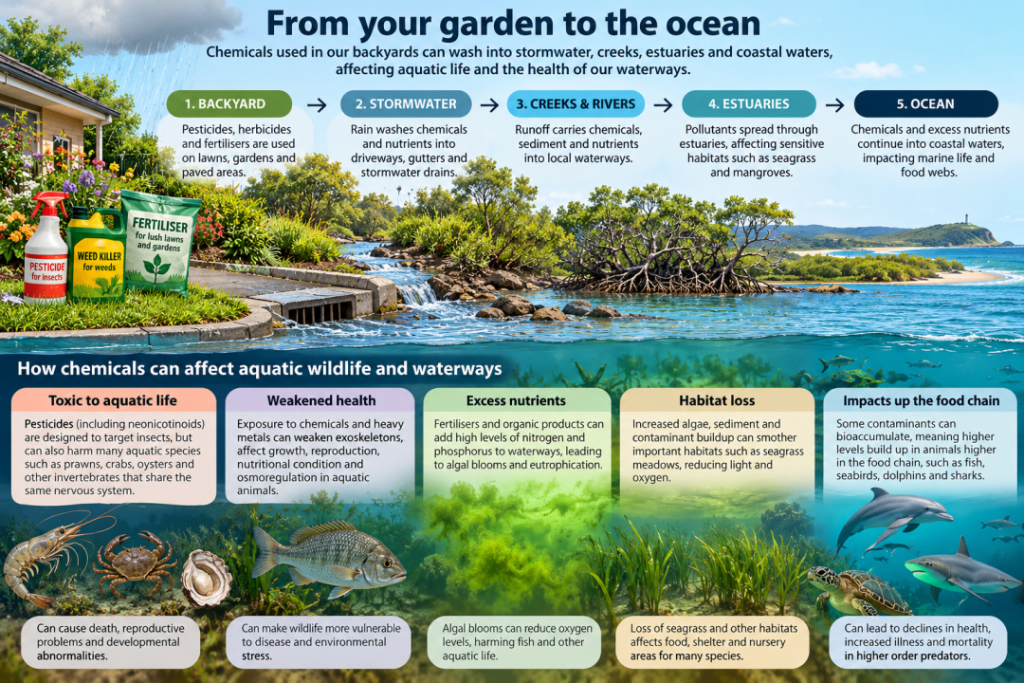
When it rains, chemicals and excess nutrients can be washed from lawns, gardens, driveways and other urban areas into stormwater drains. From there, they can travel into local creeks, rivers and estuaries, eventually reaching our coastal waters. Chemicals can also enter the environment through spray drift, drainage and runoff from other land uses, including agriculture.
The environmental impacts depend on the type of chemical, how and where it is applied, its concentration and the conditions under which wildlife is exposed.
How Can Garden Chemicals Affect Aquatic Wildlife?
Some pesticides and herbicides can be harmful to non-target species, including aquatic insects, crustaceans, molluscs, fish and aquatic plants.
Depending on the chemical and level of exposure, these substances can affect the growth, development, reproduction and survival of aquatic organisms.
Some persistent contaminants can also accumulate in living organisms, while certain substances become increasingly concentrated as they move through food webs. This can expose predators, including larger fish and marine wildlife, to contaminants through their prey.
Too Many Nutrients Can Harm Our Waterways
Fertilisers provide nutrients that help plants grow, but when excess nitrogen and phosphorus enter our waterways, they can disrupt the natural balance of aquatic ecosystems.
This process, known as eutrophication, can stimulate excessive growth of algae and aquatic plants.
As this material dies and decomposes, oxygen is consumed from the water, potentially creating low-oxygen (hypoxic) conditions that can stress or kill fish and other aquatic wildlife.
Excess nutrients can also contribute to algal blooms, reduced water quality and the degradation of important aquatic habitats.
Every garden is connected to the wider environment. By gardening with nature, we can help protect biodiversity — from the wildlife in our backyards to the aquatic and marine life in our creeks, estuaries and ocean.
Practical alternatives to use in your garden
Here’s just a few suggestions to help your garden, wildlife, waterways & ocean healthy
| Instead of… | Try this Natural Alternative | |
| Routine insecticide & pesticide spraying | Try | · Identify the pest, encourage natural predators and remove pests by hand where practical · Some insects are beneficial and are beneficial to wildlife – tolerate some damage on your plants · For some pests, such as snails, try barriers e.g. copper tape · Companion planting |
| Broad herbicide spraying for weeds | Try | · Hand weeding, mulching and targeted mechanical removal · Try boiling water on hard services (such as driveways) where weeds appear through the cracks · Try sheet mulching · Dense planting in your garden · Plant native groundcovers · Integrated solutions – such as chickens & goats · Companion planting |
| Leaving bare soil exposed | Try | · Planting groundcovers or applying suitable mulch · (in some spaces bare soil can be a good thing, but ensure that bare soil isn’t near drain or waterway where runoff can occur) |
| Automatically removing all insects | Try | · Learning which insects are beneficial and tolerating minor damage |
| Excessive fertiliser application | Try | · Add compost and worm castings · Test soil and applying nutrients only where needed (and when no rain is forecast) · Companion planting |
| Allowing garden waste into drains | Try | · Composting or disposing of garden waste appropriately |
(Please note this is general advice and it is best to do some research and investigate the best environmentally friendly option for your circumstances and issue)
* Are ‘natural’ products always safe?
It is important to consider safe natural products, as some can be harmful such as concentrated vinegar, essential oils, salt and some botanical pesticides can damage plants, soil organisms or aquatic life.
 Take An Ocean Champion Pledge & Make your garden chemical-free
Join the global movement to create positive change by taking a simple everyday action. Take a pledge and share with your friends and community on social media. Choose an action and pledge to make a change. Simply write on a piece of paper or digitally and take a photograph and share on your social media. Don’t forget to tag us @ocean_education_conservation and @dolphin_research_australia !